Most FMCG leaders can see the factory and they can see the shelf. The channel in between — where claims, pricing, reimbursements and reconciliations move between the brand and its distributors — usually runs on spreadsheets, email and WhatsApp. That is where trade spend quietly leaks, long before finance ever sees a number.
In manual distributor setups, 1–3% of net sales is lost to claim errors, pricing mismatches and stock discrepancies — with settlement cycles running 60–90 days across 8–12 distinct claim types.
Directional range drawn from our own engagements and industry benchmarks, not a single published study.
The Business Challenge
One broken process, four stakeholders carrying different parts of the load.
ASM / RSM in the field
- 30–40% of field time spent on claim disputes
- Damage, meltage and transport evidence verified by hand
- Pricing changes circulated over WhatsApp and email
Accounts & controllers
- Duplicate and FIFO claims slipping through unchecked
- 8–12 claim types, each with its own calculation logic
- Reconciliations rebuilt from scratch every cycle
Channel partners & franchisees
- Long settlement cycles straining working capital
- Q-commerce and e-commerce claims lost in spreadsheets
- No claim status visibility — trust eroding with every delay
CFO, COO and Sales Head
- No single trade-spend number across the network
- Distributor escalations landing weekly at the top
- Audit readiness resting on individual heroics
The Operating Reality
Six manual practices were quietly carrying distributor governance — each of them dependent on the people who happened to know how it worked.
- Excel everywhere. Per-claim, per-channel calculations lived in spreadsheets, passed around by email
- WhatsApp as the filing cabinet. Damage, meltage and transport evidence forwarded as photos and screenshots
- Settlement notes by hand. Per-distributor cover notes typed in Word, signed and scanned each cycle
- Challans by the hundreds. Franchisee and parlour reimbursement challans built one at a time in Excel
- Pricing by mass email. Every SKU revision triggered a fresh round of distributor mail-outs
- Status by DM. Claim updates traded over WhatsApp and phone, with no system of record
Why Earlier Digitisation Stalled
The instinct in most enterprises is to standardise the claim file and move on. It doesn't hold, because the complexity is combinatorial rather than cosmetic:
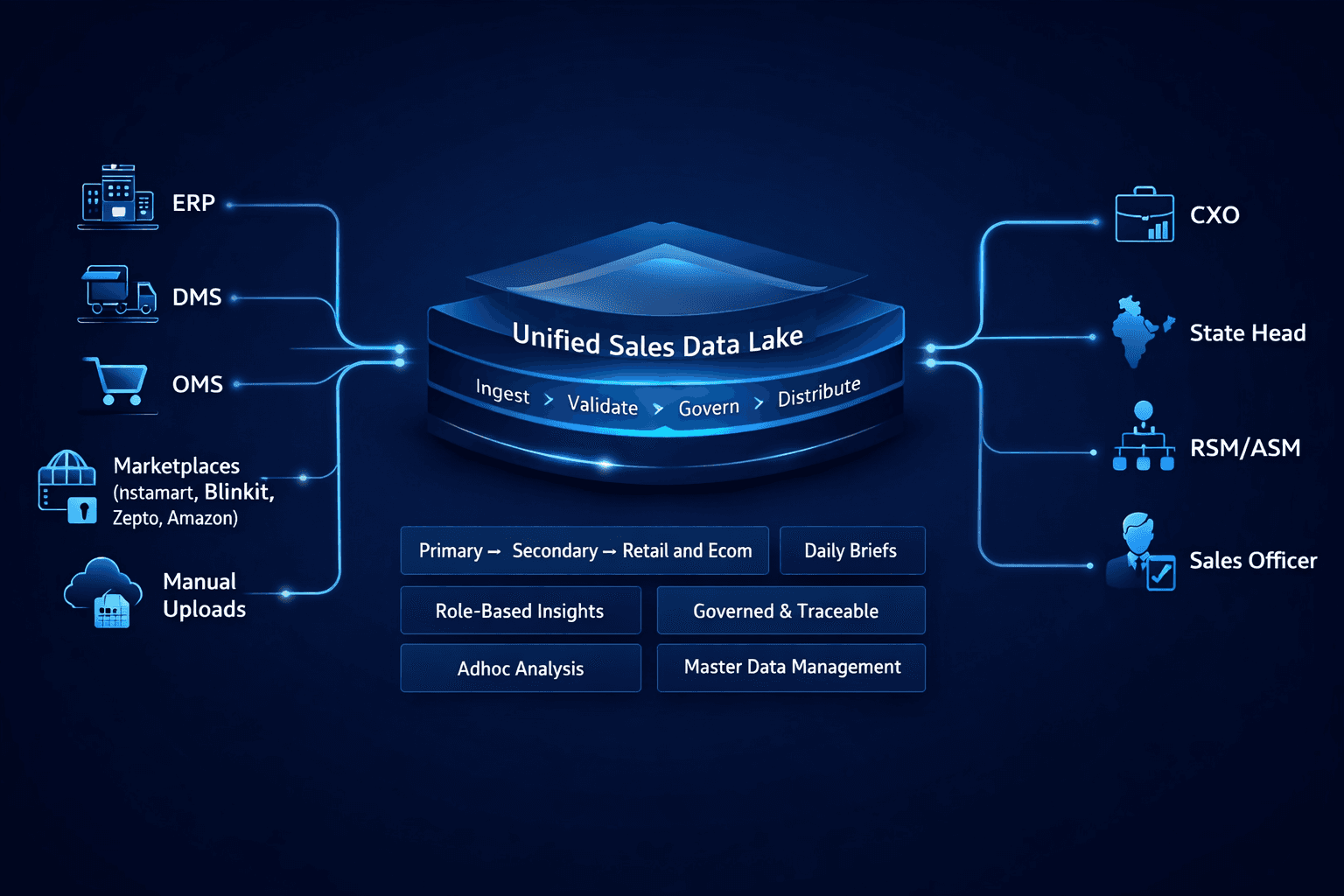
- 8+ source systems — ERP, DMS, POS, distributor uploads and internal feeds, each shipping its own data shape
- 5 channel paths — General Trade, Modern Trade, parlour, food services and quick-commerce, each carrying its own pricing rules
- 10+ claim calculations — rate difference, damages, transport, margin/MRP, promotions, display, excess/short, price variance and more
- 7+ communication touchpoints — evidence, distributor–RSM exchange, pricing comms, settlements, challans, reviews, each a manual handoff
Every combination has its own logic, and every rupee needs accountability. The job isn't standardising the work — it's governing the variation.
What We Built
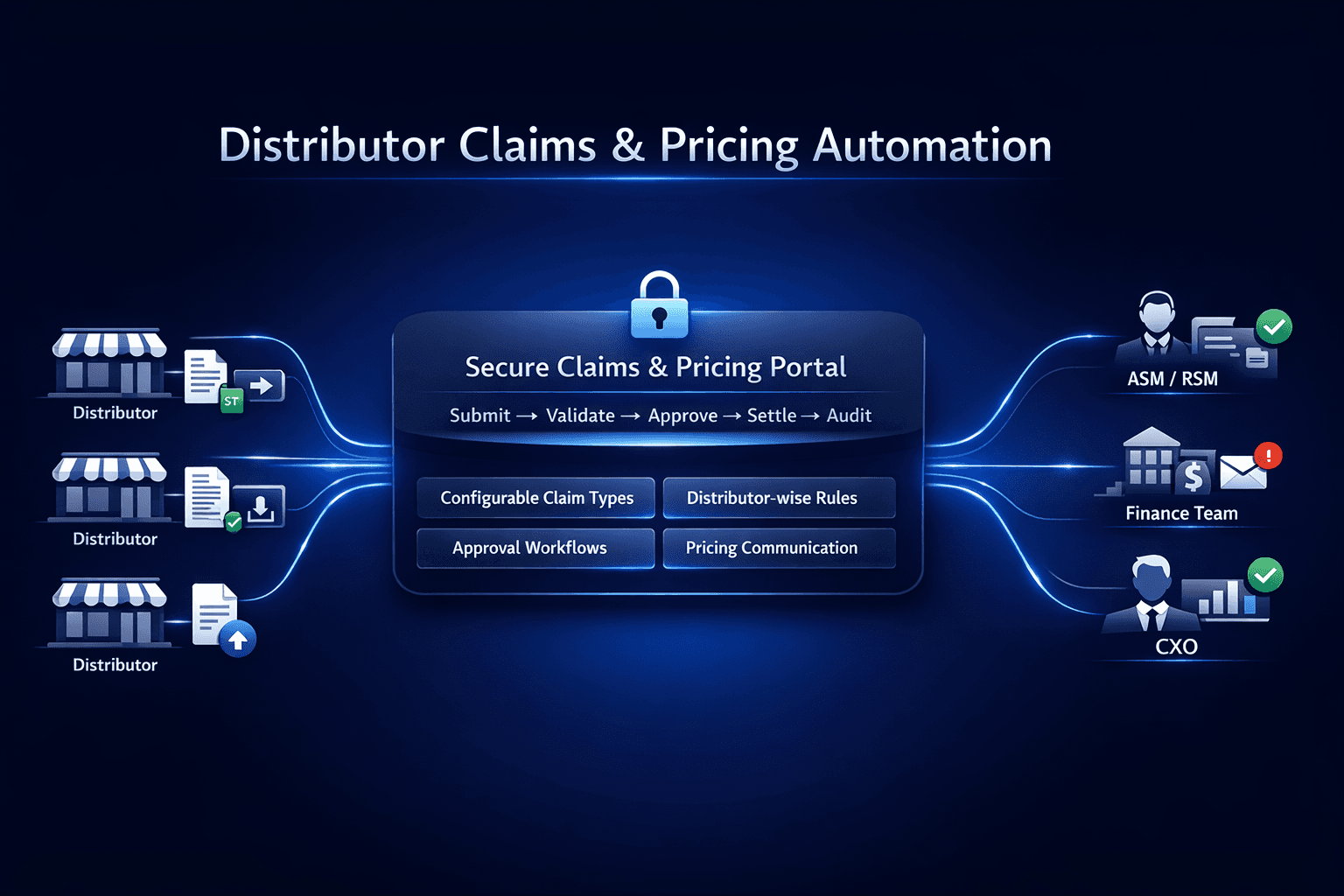
A secure claims and pricing portal enabling structured, auditable communication between distributors and business stakeholders — without disrupting existing workflows.
Configuration & Calculation Flexibility
- Fully configurable claim types at the distributor level (promotions/schemes, shortages, rate differences, damages, samples, logistics, etc.)
- Flexible settlement logic and reconciliation templates — designed to adapt to distributor-specific margin structures and changing pricing
- Centralized controls to maintain consistency without slowing down change
- Built-in automated data quality checks to prevent bad data from entering the system (including checks for FIFO sales / duplicate claims, etc.)
- Flexible, user-defined rules to ensure distributors submit only valid and approved codes (e.g., distributor code, channel code, SKU code)
Masters, Workflows & Communication
- Secure distributor-level access — each distributor sees only their own data
- Centrally managed masters (SKU, pricing, discounts) to ensure consistent communication and accurate calculations
- Centralized pricing communication — rate and scheme revisions issued to the whole network from one place, replacing per-distributor mail-outs, and read by the calculation engine as the same version distributors receive
- Role-based accountability and approvals across Distributor → ASM/RSM → Finance, enabling validation and settlement sign-off
- Automated email triggers across the entire claims lifecycle, including data ingestion notifications, approval/rejection communications, claims cover note availability, and collaboration emails
- Quick-commerce and e-commerce reimbursement and reconciliation handled in the same engine as trade claims, rather than in a parallel set of spreadsheets
How the Platform Is Wired
Many feeds in, one engine, personalised outputs. Distributors raise, RSMs review, finance governs, leadership sees the whole picture.
Ingestion & data quality
Source data manager for ERP, DMS, POS and quick-commerce feeds, plus distributor uploads — with data-quality checks at the door.
Masters
Customer, SKU, rate, margin and promotion masters held centrally, with full history behind every calculation.
Business rules
Per-claim, per-channel logic including GST and margin treatment — versioned so a rule change never rewrites the past.
Workflow & reconciliation
Approvals, alerts, adjustments and primary-vs-secondary reconciliation, with maker–checker and evidence lineage throughout.
Outputs are personalised per audience: pricing alerts, cover notes and status updates for distributors; per-outlet challans and reimbursement notes for franchisees; calculation marts, reconciliation and audit trails for finance; consolidated dashboards and variance flags for leadership.
Why This One Worked
We didn't start from a blank page. An earlier attempt built on Zoho Analytics had run for nine months and onboarded zero distributors. Three things had broken it: reconciliation logic that differed per distributor turned into a permanent development backlog, an interface non-technical distributor teams couldn't use, and processing limits that buckled at real transaction volumes. That failure told us where the design had to differ:
Standardised claim file structures across all distributors
Configurable claim structures and calculation logic per distributor
Database-only storage, holding messy Excels, image evidence and audit needs
Data-lake storage that handles structured and unstructured content natively
Each new distributor triggered a full regression of existing workflows
One-click onboarding — pilot two or three, then roll out the network in waves
New claim types or logic changes took months of development cycles
Excel-style interface to add claims or change calculations — no dev queue
No versioning — repeated distributor uploads couldn't be traced
Every data event and every action versioned, distributor-side and internal
Distributors had to log in for every update
Personalised email distribution, with a discovery layer that reads existing sheets
Using Wekalp's process discovery and flexible templates, we operationalized distributor-wise settlement logic and delivered the initiative within 3 months.
How We Delivered
A phased path where each phase ends with a working artefact rather than a document.
Discover
2–3 weeksClaim taxonomy, logic, structures and stakeholders, mapped in workshops with finance and IT.
Design
3–4 weeksMaster data model, calculation rules and automation schedules — one source-of-truth schema agreed with stakeholders.
Build
6–8 weeksPortal, engines and integrations live in pilot, with DMS, POS and ERP wired in for the first distributors.
Roll-out
8–12 weeksWave-based onboarding of the distributor network, with hyper-care and embedded support.
Sustain
OngoingQuarterly governance and analytics review, plus continuous tuning of masters and rules.
Impact
Claims cycle compressed by ~12×
Distributors on one portal with role-based access
POS transactions processed every month
Claim types automated end to end
Franchisee challans auto-generated
Channels unified — GT, MT, parlour, food services
Raised over email and spreadsheets
Raised, reviewed and settled on one portal
Every SKU revision triggered a fresh round of manual mail-outs
Revisions issued once from central masters — the rate distributors see is the rate claims calculate on
Reimbursements chased in a separate set of spreadsheets
Ingested, reconciled and settled alongside trade claims
Investigated reactively, after the dispute
Flagged by validation rules before settlement
Distributor communication ad-hoc and hard to audit
Full history and audit trail on every settlement
- Faster settlements and faster, consistent pricing communication across the network
- Real-time 360° visibility of claim status for distributors and leadership
- Revenue leakage prevented through structured validations and audit-ready workflows
- Seamless audits and fewer escalations through a single system of record
- Distributor trust restored — and a scalable foundation for finance automation and data lake initiatives
What's Next
- Finance close automation
- Customer loyalty analytics
Claims automation only works when the platform adapts to real-world complexity. In this rollout, distributor-specific rules and approvals were the core challenge — and flexible configuration is what enabled speed, adoption, and audit-ready execution.
Key Takeaway